

At Cellistic, our people are at the heart of turning iPSC-derived cell therapies into clinical reality.
In this series, we meet the experts who make the difference — sharing their insights, challenges, and what drives them every day.
Each week, one of our experts answers three questions, offering a closer look at the minds shaping the future of iPSC-based therapies — and making the difference that counts to bring those therapies to patients.
December 15, 2025
She Makes the Difference: Sarah Legrain, PhD
Program Manager
In this new Science in Person story, we meet Sarah Legrain, Program Manager at Cellistic, whose work connects internal teams and external partners to keep every project on course. She also hints at a newly available expansion to Cellistic’s GMP manufacturing platforms, now accessible to cell therapy developers.
December 10, 2025
He Makes the Difference: Pierre-Baptiste Rousseau
Production Manager
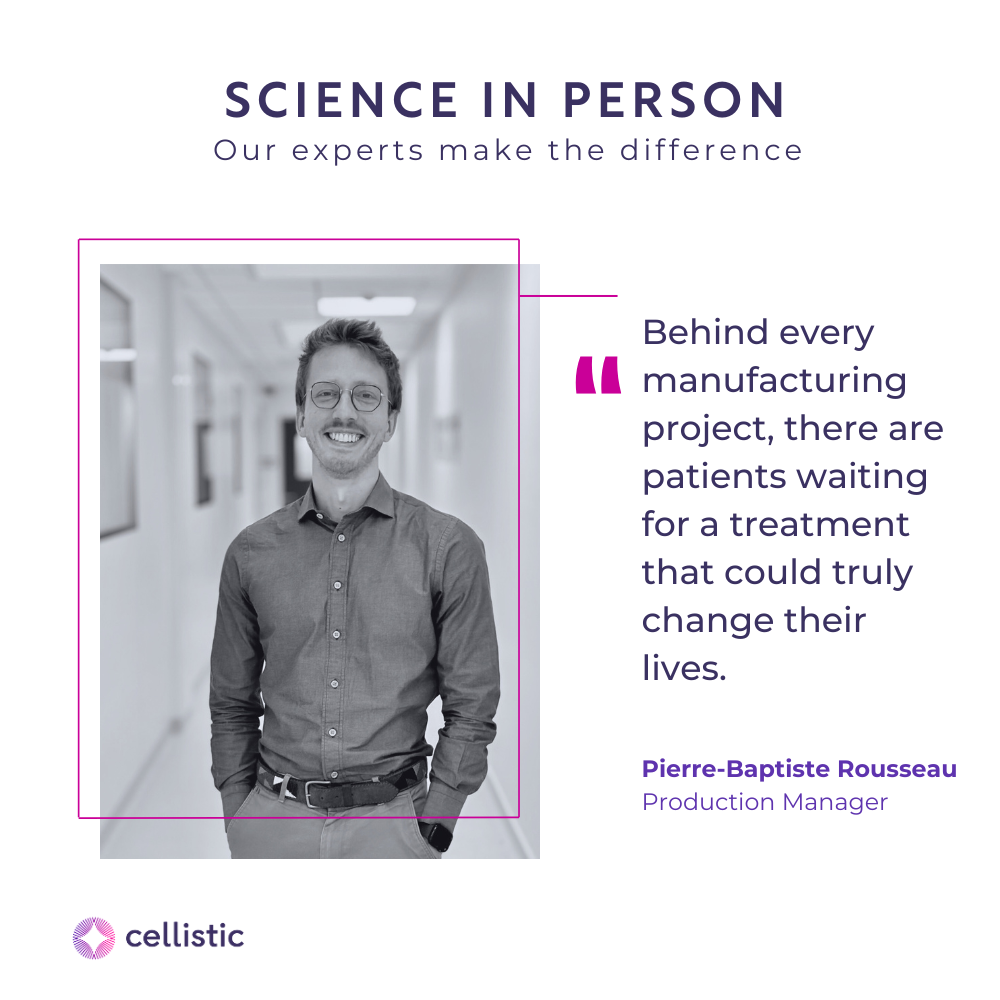
Pierre-Baptiste Rousseau is next to take his turn in our experts campaign, offering a look into what drives him as Production Manager in a purpose-built GMP manufacturing facility dedicated to iPSC-based therapies. He shares how production truly starts before anyone steps into the cleanrooms and how his team’s work shapes the final product our customers take into the clinic.
1. What excites you most about working on iPSC-derived allogeneic therapies at Cellistic?
What excites me the most about working on iPSC-derived allogeneic therapies is the opportunity to really change the paradigm of how cell therapies are made and delivered.
Coming from years in clinical manufacturing, I’ve seen how complex and patient-specific autologous therapies can be. With iPSCs, we have the potential to create an off-the-shelf solution — scalable, standardized, and accessible to many more patients. It’s inspiring to be part of a team that’s pioneering this shift and building the processes and technologies that can make this vision a reality.
2. How does your work at Cellistic contribute to delivering therapies to patients efficiently and at scale?
As a production manager in the GMP facility, my role focuses on transforming innovation from our development department into robust, compliant, and scalable manufacturing processes.
We make sure that what works in development can be reproduced consistently and safely at GMP scale.
That means setting up efficient workflows, ensuring equipment reliability, and fostering a strong quality and continuous improvement culture within the team.
Ultimately, this ensures our customers can bring their therapies to patients faster, with the highest standards of quality and reproducibility.
3. When you think about the therapies our customers are developing, what motivates you?
What motivates me is knowing that behind every project, there are patients waiting for a treatment that could truly change their lives. Our customers are developing therapies for conditions that currently have few or no options — and our work helps make those treatments possible. Seeing that connection between what we do every day in manufacturing and the potential impact on patients is incredibly rewarding.
It gives a real sense of purpose to everything we do at Cellistic.
November 24, 2025
She Makes the Difference: Sophie Gailly
QA Manager
Today, we sit down with Sophie Gailly, who leads Cellistic’s Quality Assurance team. Like the other experts highlighted in this campaign — and many more working behind the scenes — her role is absolutely essential.
Sophie oversees the implementation of GMP workflows from the earliest stages of development and is responsible for securing and maintaining the certification of our GMP manufacturing facility, a critical responsibility in enabling the compliant manufacturing of advanced cell therapies that meet regulatory requirements, which is what we do at Cellistic.
1. In your role, what’s one thing people might not realize about what it takes to bring these therapies to life?
Quality assurance is often described as “working in the shadows”, but in fact, quality is the foundation that makes therapies possible. People might not realize, the extensive amount of document review and preparation to start a manufacturing run and approve a product release. These review and preparation ensure patient safety, regulatory compliance, consistency, and reliability. QA is not just about checking boxes, it allows innovations to reach patients safely, and that requires precision, commitment, and teamwork at every step.
2. What excites you most about working on iPSC-derived allogeneic therapies at Cellistic?
From an early age, I knew I wanted to contribute to medical innovation, help save lives, and working at Cellistic feels like reaching that goals. The potential of iPSC-derived allogeneic treatments is incredible: new options for patients, scalable manufacturing, and faster access to care. Being part of the boat, helping to define and develop these therapies bring daily challenges, continuous learning, and real sense of purpose. For me, being on this boat, it’s a great opportunity to make a difference for patients.
3. What’s the most exciting project or challenge you’ve worked on recently?
Leading the implementation of our GMP Quality Management system, is one of the most challenging and rewarding projects I have managed at Cellistic. Starting from scratch, we built and validated an electronic QMS, defined processes and implemented documentation required to ensure full GMP compliance. We also integrated the flexibility required for cell line development through a risk-based approach. As project lead, I coordinated the cross-functional teams to ensure GMP readiness. It really makes me proud that Belgian authorities operating under EMA guidelines and expert auditors during client audits consistently reaffirm our GMP certification with positive feedback at each visit, confirming the strength of our QMS structure.
.png?width=1000&height=1000&name=Experts_Sophie%20(2).png)
November 17, 2025
He Makes the Difference: Jonathan Tournay
Production Technician
In our ongoing series highlighting the people behind Cellistic’s capabilities, we speak with Jonathan Tournay, Production Expert. With over ten years of experience in GMP cell therapy manufacturing, Jonathan shares how process rigor, cross-team coordination, and anticipation drive the translation of iPSC processes into reliable production workflows.
1. What’s one tool, technique, or habit you rely on every day in your work?
I rely a lot on sticking to solid, standardized cell-culture routines. In production, the small things matter: checking bioreactor readings, keeping things clean and organized, and making sure the team is aligned. One habit that really helps me is staying one step ahead. Knowing what’s coming next keeps the workflow smooth and helps us deliver consistent, high-quality batches.
2. What’s the most exciting thing you’ve worked on recently at Cellistic?
Lately, I’ve been helping optimize a process to turn hiPSCs into Natural Killer T cells in our bioreactors. It’s exciting to take something that starts as a lab protocol and make it work reliably at a larger scale. Seeing it come together, keeping the biology intact while pushing toward industrial production, really shows what we’re building at Cellistic.
3. When you think about the therapies our customers are developing, what motivates you?
What keeps me motivated is knowing that every batch we run could eventually support a treatment for someone who really needs it. We’re not just growing cells, we’re part of a much bigger effort to move new therapies forward. That’s something I’m proud to contribute to every day.
Explore Cellistic's GMP Manufacturing facility here.

November 10, 2025
She Makes the Difference: Hind Ghezraoui, PhD
Principal Scientist, Cell Line Development
This week, we sit down with Hind Ghezraoui, Principal Scientist in our Cell Line Development team, to talk about what drives her work in the industry after years in academic research — from translating iPSC and CRISPR science into real-world applications to the satisfaction of seeing customers’ projects move one step closer to patients.
1. What excites you most about translating iPSC-derived cell therapy science into real-world applications?
As someone who spent many years in academia working with CRISPR and studying DNA repair mechanisms in the immune system and cancer, my research was impactful but remained largely at the fundamental level, without direct translation to patients.
Transitioning into the field of cell therapy, where the work directly contributes to developing treatments that can save lives, is truly inspiring.
Combining two Nobel Prize–winning technologies CRISPR and iPSCs to create transformative therapies feels like the ultimate culmination of scientific progress, bringing precision and purpose together in an incredibly meaningful way.
2. What’s the most inspiring moment you’ve had working with a customer team?
One of the most inspiring moments working with a customer team was when we met all project goals on time, delivering high-quality data under tight deadlines. Seeing the customers’ excitement and knowing that our support helped them move their therapy closer to patients was incredibly rewarding, it reminded me why what we do at Cellistic truly matters.
3. At Cellistic, what part of your work in Cell Line Development do you find most impactful in advancing therapies for patients?
To me, the Pulse™ platform is at the heart of Cellistic’s mission. I guide the CLD team to work efficiently, maintain high data quality, and deliver results on time, all while keeping the bigger purpose in mind: turning iPSCs and STAR-CRISPR™ technology into life-changing therapies for patients.
Want to discover more from Hind's work? Watch the webinar she hosted together with Suzanne Snellenberg on advanced genome engineering approaches for iPSCs.
.gif?width=1200&height=1200&name=Cellistic%20Blog%20Featured%20Images%20(1200%20x%201200%20px).gif)
November 3, 2025
She Makes the Difference: Cécile Augereau, PhD
Cell Therapy Innovation Director
To open this series, we spent time with Cécile Augereau, our Director of Cell Therapy Innovation, to understand what it really looks like to build iPSC-derived therapies from idea to clinical-ready reality.
In this conversation, Cécile reflects on what makes working on allogeneic iPSC technology so genuinely exciting from a scientific standpoint, and the part of scaling iPSC-based processes that most people don’t fully see until they’re in it.
"The fact that you can just take one cell from the body, reprogram this cell into a pluripotent stem cell and from this iPS generate all the cell types of the body is just incredible, right?
Watch the interview to hear Cécile’s perspective first hand: